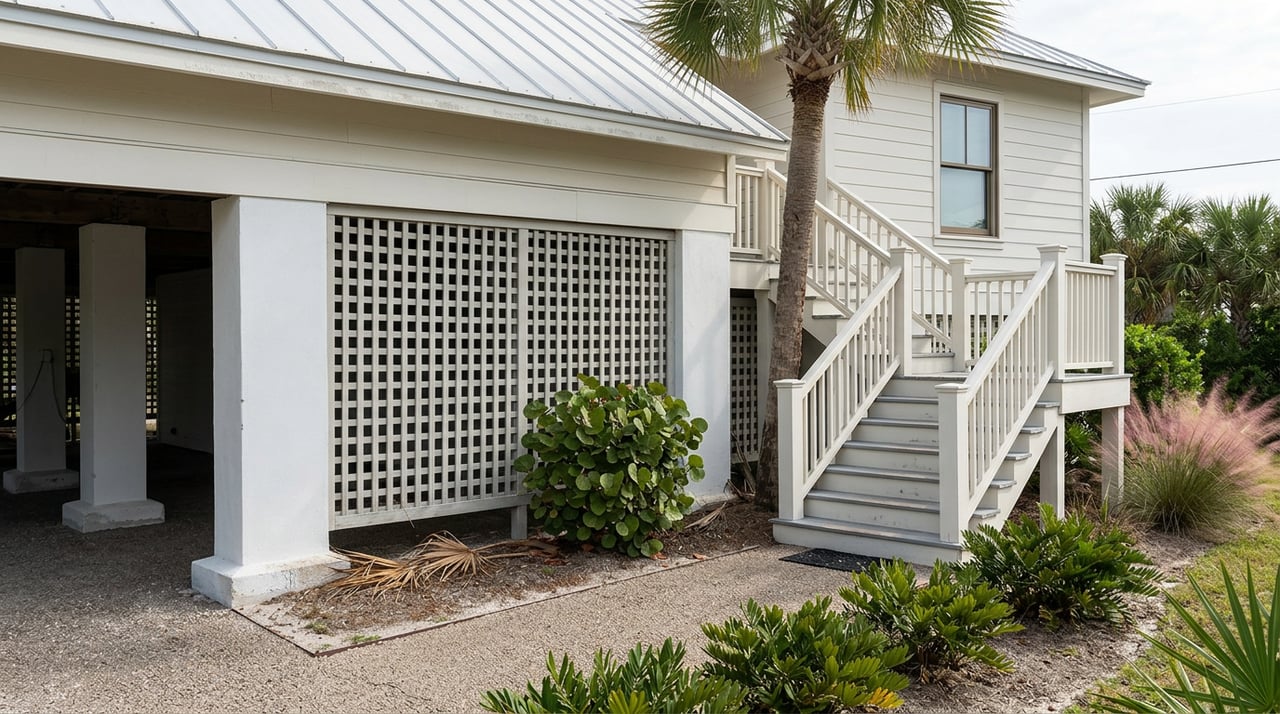
How Historic Status Affects Old Naples Cottage Renovations
Two cottages sit four blocks apart in Old Naples. Same era, same modest 1,800 square feet, same asking price near $2 million for the land and the structure on it. A buyer touring both would be forgiven for treating them as interchangeable. They are not. One can be gutted, rewired, re-plumbed and substantially rebuilt while keeping its original footprint and elevation. The other, if a contractor's estimate crosses a specific dollar threshold, must be raised on stilts to current flood elevation or torn down and started over. Nothing about the house's condition tells you which future it's headed for. The answer depends on the property’s designation and the applicable City of Naples rules.
The mechanism is Florida's Substantial Improvement rule, commonly shorthanded as the 50% Rule. If the cost of repairs or renovations to a structure equals or exceeds half of that structure's market value (the building alone, not the land under it) within a twelve-month window, the entire building has to be brought up to the current Florida Building Code and current floodplain standards. For an older Old Naples cottage sitting below today's required flood elevation, that usually means the whole house gets elevated, a project that can run well past the value of the renovation that triggered it in the first place. The City of Naples building department walks through the definitions of base flood elevation and substantial improvement on its own site, and it is worth reviewing before planning work on a fixer.
This is why so many of Old Naples' older homes have historically traded near land value. A buyer who wanted to update a 1950s block home past a certain point wasn't really choosing between renovation and new construction. They were choosing between renovation-that-becomes-a-full-rebuild and just building new from the start. For years, that math pushed toward teardowns across the neighborhood.
As Florida Weekly reported, in March 2020, Naples City Council approved an exemption that changes the equation for one category of home: structures with historic status. Under the city's floodplain ordinance, a historic building can qualify for a variance that exempts qualifying repair, improvement or rehabilitation work from being counted as a substantial improvement at all, provided the work doesn't compromise the structure's continued historic designation. The city defines a historic building broadly for this purpose. It covers a property individually listed in the National Register of Historic Places, a contributing structure inside a listed historic district, a property with an approved local or state designation, or one the Florida State Historic Preservation Officer has determined eligible for listing. The ordinance itself lays out the exact language, including the requirement that the City of Naples currently has no separate local historic-designation program of its own, which pushes most determinations through the state review process.
The Naples Historical Society had pushed for exactly this change, and its later explainer on the subject was blunt about what the 50% Rule had been doing to the city's older housing stock before the exemption existed. The Society's documentary on historic rehabilitation, produced with local filmmaker Fiddler Films, frames the 2020 change as removing a major driver of demolitions. The exemption only removes that code-compliance consequence for qualifying work.
A house that qualifies for historic status isn't just older. It's carrying a permitting advantage that a nearly identical, non-designated neighbor two streets over doesn't have. That advantage shows up in what a buyer can actually do with the place, not just in what it looks like from the sidewalk.
If a structure sits inside the recognized Naples Historic District, the city's own process document lays out what happens next. Interior work that doesn't touch the exterior can generally proceed straight to a Historic Building permit application through the city's CityView portal. Exterior work, replacing windows, doors, roofing or siding, needs a review from the State Historic Preservation Office first, with a stated 30 day turnaround. Buildings that sit outside the recognized district but might still qualify are routed through a separate state eligibility application before the same steps apply. Either way, the final submission includes the historic exemption form, a floodplain elevation certificate, and a letter of support from the Naples Historical Society.
None of that is a rubber stamp. It is a real review process with a real timeline. But it is a fundamentally different path than the one facing a non-designated cottage, where a contractor's estimate crossing the 50% threshold ends the conversation about renovating in place.
The gap this creates shows up in the market data itself. Across the broader Old Naples footprint, the median sale price over the three months ending in June 2026 was $1.8 million, up 10.6% from the same period a year earlier, with homes selling at roughly $930 per square foot and moving from listing to closing in about 74 days, down from 106 days a year prior. That is the neighborhood-wide number, the one most portals will show a buyer searching for "Old Naples homes."
Narrow the lens to the Naples Historic District itself, the tighter core of recognized historic cottages and contributing structures, and the picture changes. That smaller pool of homes has consistently traded at a steep premium over the neighborhood-wide figure above, well beyond what lot size or beach proximity alone would explain. Part of that gap is scarcity and location, including nearness to Third Street South. But part of it is this: a buyer paying for a historic-designated cottage is also paying for renovation optionality that a comparable non-designated structure a few blocks away doesn't carry. The house may be smaller, older, and need more work on paper. It is also one that can be substantially rehabilitated without triggering a full elevation, where the identical project on a non-designated neighbor might force exactly that outcome.
This is worth sitting with if you are comparing two Old Naples properties on price and square footage alone. Ask whether the property carries the exemption before comparing its renovation potential.
For a buyer weighing an older Old Naples cottage against a renovation budget, a few questions matter more than curb appeal:
None of this replaces a licensed appraiser's determination of structure value or a contractor's cost estimate. It does mean the conversation about a cottage's renovation potential should start before the inspection period, not during it.
For a buyer or investor thinking about Old Naples as a redevelopment or renovation play, this single administrative fact is often more decisive than the number of bedrooms or the age of the roof. It can shape whether a property is a renovation candidate or may require a more extensive rebuild. It also explains, at least in part, why two cottages that look alike from the street can carry very different price tags and very different futures.
If you are evaluating a specific Old Naples property and want to understand what its designation status actually means for your renovation or rebuild plans, that is exactly the kind of question The Silvers Group works through with buyers and owners before an offer goes in, not after. Schedule a consultation to walk through a specific address, or join our private listings list to see Old Naples opportunities before they're broadly marketed.
This article is general information, not legal, tax or financial advice. Consult a qualified professional about your situation.

Bringing together a team with the passion, dedication, and resources to help our clients reach their buying and selling goals. With you every step of the way.
Get In Touch With Our Team To Learn More